There is a lot of “AI agent” marketing flying around right now. Most of it is a chatbot in a nicer jacket.
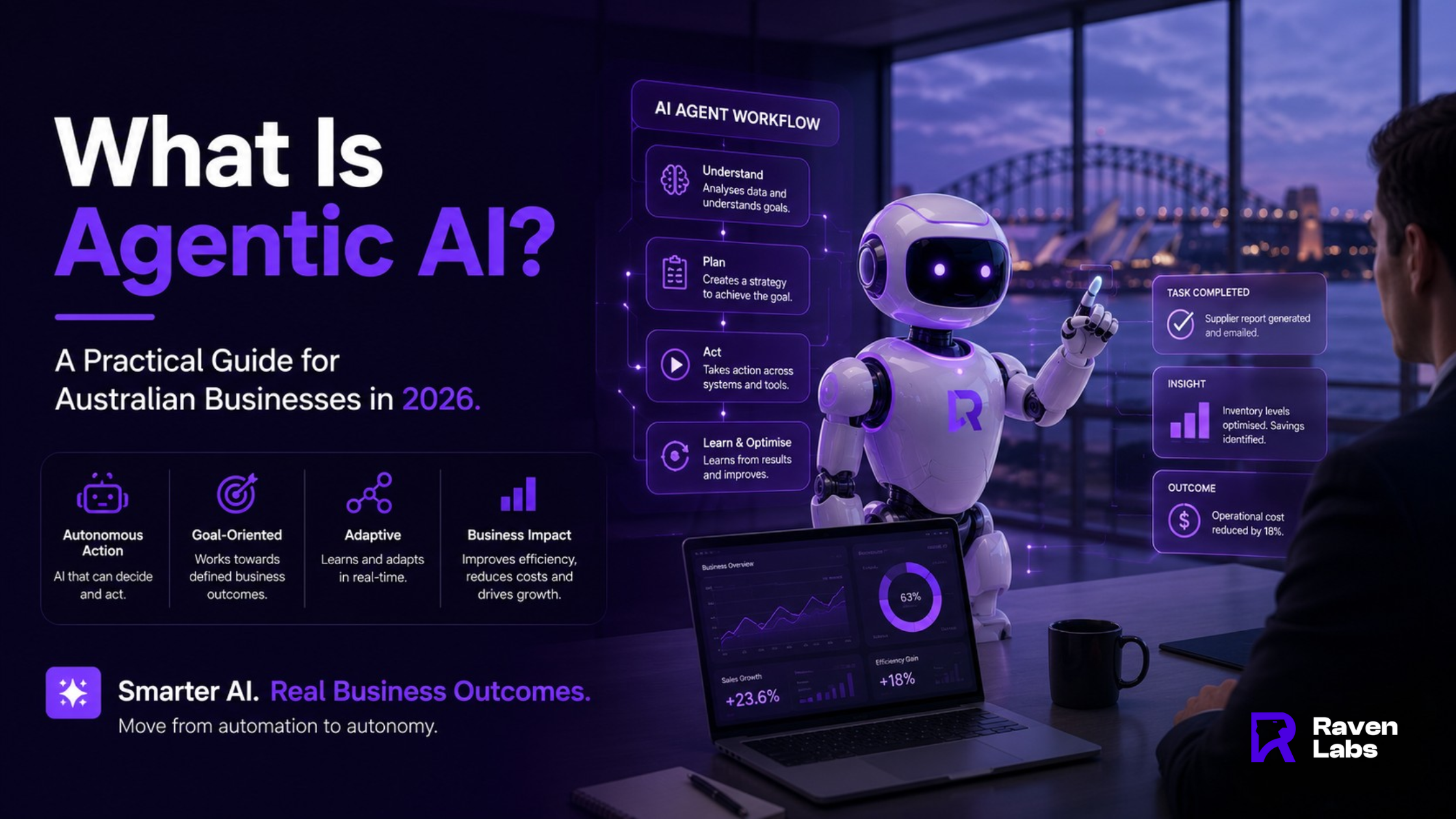
Here is the actual difference, in one line: a chatbot answers a question, while agentic AI takes a goal and does the multi-step work to reach it pulling data, using tools, and making decisions along the way, with far less human hand-holding.
Introduction
Agentic AI describes an AI system that perceives information, reasons toward a defined goal, and takes action across multiple tools and systems without a human directing every individual step.
Rather than a person prompting an AI to “write an email,” an agent can be instructed to “qualify these 50 leads and book the qualified ones into the sales calendar” and it will work through the reading, judging and system updates needed to get there, checking in with a human only where the guardrails require it.
How It Differs From Traditional AI Automation
Traditional, rule-based automation (often called RPA) follows a fixed script: if this happens, do that. It is reliable and cheap for repetitive, structured tasks, but it breaks the moment something outside the script occurs. Generative AI, the wave before agentic AI, produces content text, summaries, drafts in response to a single prompt, then waits for the next instruction.
Agentic AI is the next layer up: it combines reasoning with the ability to act across systems, adapting as it goes rather than following a fixed path or waiting to be re-prompted for every step.
Real Use Cases for Australian Businesses in 2026
The most common deployments we see across Australian SMEs right now include customer service triage (sorting and drafting responses to support tickets before a human touches them), invoice processing (reading an invoice, matching it to a purchase order, and routing it for approval), and sales research agents (pulling together prospect information that used to take an analyst an afternoon, now done in minutes).
Regulated, admin-heavy sectors including professional services and businesses managing high documentation volumes tend to see the fastest return, because the manual overhead they are replacing is highest.
Agentic AI is a genuine productivity multiplier, but only on top of clean data and clearly defined processes. If a human on your team could not follow your current process step by step, an AI agent will not be able to either.
That means auditing your data sources and documenting your workflows before handing anything over the preparation work is unglamorous, but it is what determines whether an agent succeeds or quietly produces bad outcomes at scale.
Where It Goes Wrong Without Oversight
The three practical risks to manage are the agent acting on incorrect information (hallucination), the agent taking the wrong action inside a connected system, and confidentiality an agent inadvertently exposing sensitive data it was given access to.
None of these are reasons to avoid agentic AI; they are reasons to build in human checkpoints for higher-stakes actions and start with a single, well-scoped workflow rather than handing over an entire department on day one.
What You Need Before You Start
Where Australia Actually Sits in 2026
Australian adoption of agentic AI in 2026 sits in what analysts describe as an intermediate phase well past early experimentation, but not yet at the most mature deployment levels seen in some overseas markets.
A significant share of Australian businesses have experimented with AI in some form, but a much smaller proportion have moved from pilot projects into fully embedded, production use. The gap between those two groups is where the real competitive advantage currently sits.
Is Your Business Ready for This?
Curious whether your business is agentic-AI ready, or whether you need a simpler automation first?
Book a free AI readiness assessment and we will map exactly where agentic AI fits your business.
Talk to us –
Visit theravenlabs.com or call 1300 305 009.
FAQ’S
1. What is the difference between agentic AI and a chatbot?
A chatbot answers questions it is asked, one interaction at a time. Agentic AI is given a goal and works through the multi-step actions needed to achieve it reading data, using tools, updating systems with minimal ongoing human prompting.
2. Is agentic AI the same as RPA (robotic process automation)?
No. RPA follows fixed, rule-based scripts for structured, repetitive tasks. Agentic AI reasons and adapts across variable situations, making it suited to tasks that involve judgement rather than a strictly fixed sequence of steps.
3. What data do I need before implementing agentic AI in my business?
Clean, accessible data and clearly documented processes are the two prerequisites. An agent will amplify whatever it is given, so messy data or undefined processes tend to produce unreliable results.
4. Which Australian industries are adopting agentic AI fastest in 2026?
Regulated, documentation-heavy sectors including professional services and businesses with high compliance or paperwork burden are seeing some of the strongest early returns, alongside broader use in customer service and sales operations across most industries.
5. Will agentic AI replace jobs in my business?
Most Australian deployments to date have reassigned staff away from repetitive administrative work rather than replacing headcount outright, though pure data-entry and highly repetitive administrative roles are the most exposed over the medium term.